By Dan Mauragis
The National Library of South Africa (NLSA) is a unique one. It is not one central building and is instead a pair of libraries which work in symphony with one another. These libraries are located in Cape Town and Pretoria. Pretoria is the administrative heart of the national library system.
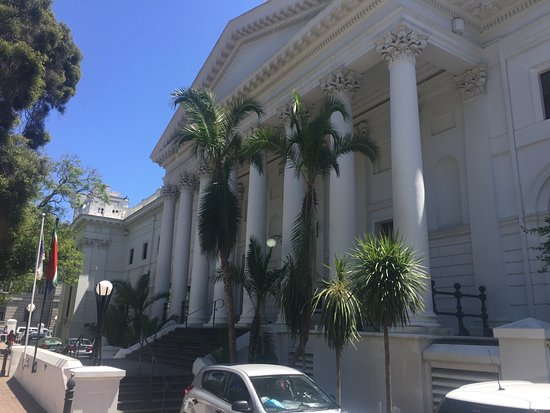
The dual libraries were both founded in the 1800s but it wasn’t until 1999 when the libraries officially had merged into a single entity. The South African Library in Cape Town was founded in 1818 to serve as the very first public library in South Africa. Taxation on wine funded the foundation of the Cape Town library. In Pretoria, the State Library was founded in 1887.
The experimental dual system was first proposed as far back as 1955. However, racial policies limited access of the library to non-white citizens which was a contributing factor to the delays in a compromise between the two libraries. The National Party held policies which prevented non-white users access to the library despite protests from the library professionals in the South African Library. Finally, in 1998 the National Library of South Africa Act 92 of 1998 passed and in 1999 the “new” national library, the NLSA, was truly born.

The National Library of South Africa has the following mandate from the government:
- promote optimal access to published documents nationally and internationally
- provide reference and information services, nationally and internationally
- promote information awareness and information literacy
A board of directors is appointed by the minister of Finance. This comes as quite a surprise as one might expect this role to be held by the minister of Education. One of the points of contention when establishing the NLSA was the financial status of the Cape Town campus. It has often relied extremely heavily on funding from the ruling government. When the National Party was removed from power in 1994, the library was in dire straits financially. In the National Library of South Africa Act of 1998, there is a requirement for a yearly audit and report of the Library’s financial status. These are published publicly on the libraries’ website.
Presently, both libraries share their resources. Documents and other collections are considered to be national treasures by the NLSA. With the combined resources, both libraries work diligently to digitize and even translate documents to all official languages in South Africa. In addition, the NLSA has undertaken a new mission in training other libraries in preservation and disaster management. This includes topics such as proper handling of books, digitization, and book repair.
Works Cited:
About Us – NLSA. (n.d.). Retrieved June 25, 2019, from http://www.nlsa.ac.za/?page_id=25
Coates, P. R. (2015). The South African Library as a state-aided national library in the era of apartheid : an administrative history (Doctoral dissertation). Retrieved from OpenUCT.
Information Access Services – NLSA. (n.d.). Retrieved June 25, 2019, from http://www.nlsa.ac.za/?page_id=19
SA Public Library. (n.d). Retrieved June 25, 2019, from http://capetownhistory.com/?page_id=463
South African Library, Cape Town. (n.d). Retrieved June 25, 2019, from https://www.sahistory.org.za/place/south-african-library-cape-town
The National Library of South Africa Act 92 of 1998.
 Our National Libraries